
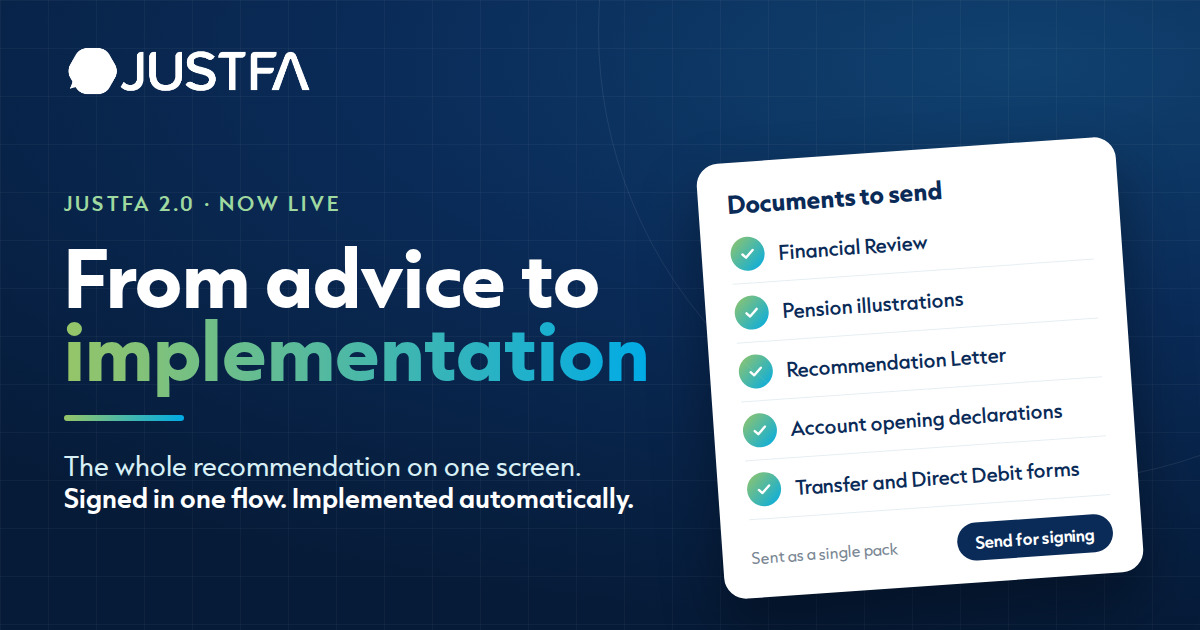

With JustFA 2.0, an adviser no longer writes up a recommendation and then carries it, step by step, into implementation. It is built once, on one screen, and everything else follows: the documents, the client’s signatures, the accounts, the transfers and the payments.
JustFA 2.0 went live on 22 September 2026. At its centre is the new Recommendation Wizard, and with it a very different advice flow: a more streamlined process for advisers and a significantly better experience for clients. Many IFA firms asked for it, and the feedback from those already using it has been really positive. This guide explains how the new flow works, what changes for advisers and for clients, and why it works the way it does on JustFA.
How the Recommendation Wizard works
The Wizard is a single screen in the JustFA back office. It opens from the client’s Financial Review, JustFA’s digital fact-find, and pulls the relevant client data straight in. From there the adviser sets up the whole recommendation and its implementation in one place:
-
Services: create one-off and ongoing services, or amend an existing ongoing service
-
Accounts: review the client’s current investment and pension accounts, and open new ISA, SIPP or GIA accounts on JustFA where the recommendation calls for them
-
Goals: link each account to the goal it serves
-
Transfers and payments: set up transfers from existing plans, one-off payments and regular payments, and review any payments already in place
With the recommendation configured, JustFA generates the document pack from it. That means a draft Recommendation Letter (the client’s suitability report) or Annual Review from the firm’s own templates, which the adviser completes and uploads as the final version; pension illustrations for pension goals; a Financial Review document containing the full fact-find; the client service agreements; and the implementation documents, such as account opening declarations, transfer forms and Direct Debit forms.
The adviser can open and check any document in the pack, then send the whole pack in one go. The client receives an email with a link and signs everything in a single guided flow, in the order the documents need to be signed. Once they sign, the recommendation is implemented automatically: accounts open, and transfers and payments are set up. If something needs to change before the client signs anything, the adviser can revoke the pack, which removes it from the client’s signing area and reopens the recommendation for editing.
Existing users will notice one other change. Goals and accounts are now managed in the Wizard, so the goals screen in the Financial Review holds only the client’s objectives.
What changes for advisers
The recommendation and its implementation now sit on the same screen. The services, accounts, goals, transfers and payments that make up a recommendation are set together, and the documents are produced from what is set there rather than prepared alongside it. That makes for a simpler process, because setting up the recommendation, producing its documents and arranging its implementation no longer happen in different places.
It is also more transparent. Before anything reaches the client, the adviser can see the full recommendation on one screen and open every generated document. Nothing has to go out unchecked, and until the client signs, the pack can be pulled back.
Annual reviews run through the same screen. Opening the Wizard during a review lets the adviser check the client’s ongoing service and amend it, review or change the payments already in place, add a transfer or a new account if the review calls for one, and generate the Annual Review document from the firm’s template. For firms scheduling Consumer Duty reviews across a client bank, that turns the review from a document-writing task into a configuration task with a document at the end of it.
What changes for clients
For clients the difference is easier to see. Instead of documents arriving one at a time, they get one email and one clear place to review and sign everything, with the documents in the order they need to be signed. It is simple to follow: they can see the full set before signing any of it, and finish in one sitting or come back to it later.
That sounds like a small thing until you compare it with what many clients still receive: a series of PDFs, several emails and at least one form to print, sign and post back. We have written before about what clients now expect from a portal; the signing flow is where that expectation meets the advice process.
Why JustFA is different from other platforms
JustFA brings the fact-find, risk profiling, recommendation and investment platform together in one system. Two things follow from that, and they are why the new flow works the way it does.
First, all of the adviser’s documents come from a single source of client data, so they are fully consistent with each other. The letter, illustrations, agreements, and account-opening, transfer, and Direct Debit forms are generated from the same recommendation, so they cannot disagree. That matters as much for the file as for the client: the recommendation, the documents produced from it, and the client’s signatures sit together on the platform. For a firm evidencing its process under the Consumer Duty, a process-created record is worth more than one assembled afterwards.
Second, because the advice process and the investment platform are linked, the adviser’s recommendation is implemented automatically once the client has signed. The signed pack is the instruction. Accounts open, and transfers and payments set up, without a separate round of instructions to a platform.
Most firms run the advice process across several systems. Intelliflo’s 2026 UK Advice Efficiency Survey found that 60.7% of advice firms run five or more core systems and 63% report poor system integration. Its 2024 survey found that firms spend 3.5 hours implementing a new client’s plan, and Intelliflo reports an average of 45 working days a year on financial plan implementation. When the back office does not invest and the platform does not advise, that work falls between them. We wrote about the wider cost of running separate systems in Building an Integrated Tech Stack That Actually Talks to Itself.
What stays with the adviser
A few boundaries, because they are the questions advisers ask first.
The Recommendation Letter is a draft generated from the firm’s template, and the adviser finishes it: download, complete, upload the final version. Illustrations are produced for pension goals. Suitability remains the adviser’s judgement and the adviser’s responsibility. JustFA is a technology platform; it does not give advice.
For most firms, the recommendation marks the point where the advice ends and a separate implementation process begins. In JustFA 2.0 they are one flow, and the client experiences it that way too.