

If you run an advice firm, most of your clients probably pay for an ongoing service. Across the market, 88% of retail clients receive ongoing advice, according to the FCA's survey of more than 4,100 advice firms (FCA, April 2026).
So two questions matter. Can you show that each of those clients got what they pay for? And what happens to your review process if the FCA drops the annual review requirement?
You don't have to guess what the FCA looks for: it has checked delivery at 22 large firms and proposed an answer to the second question. Below is what it found and proposed, then the work that doesn't need to wait for final rules.
What the FCA found when it checked ongoing reviews
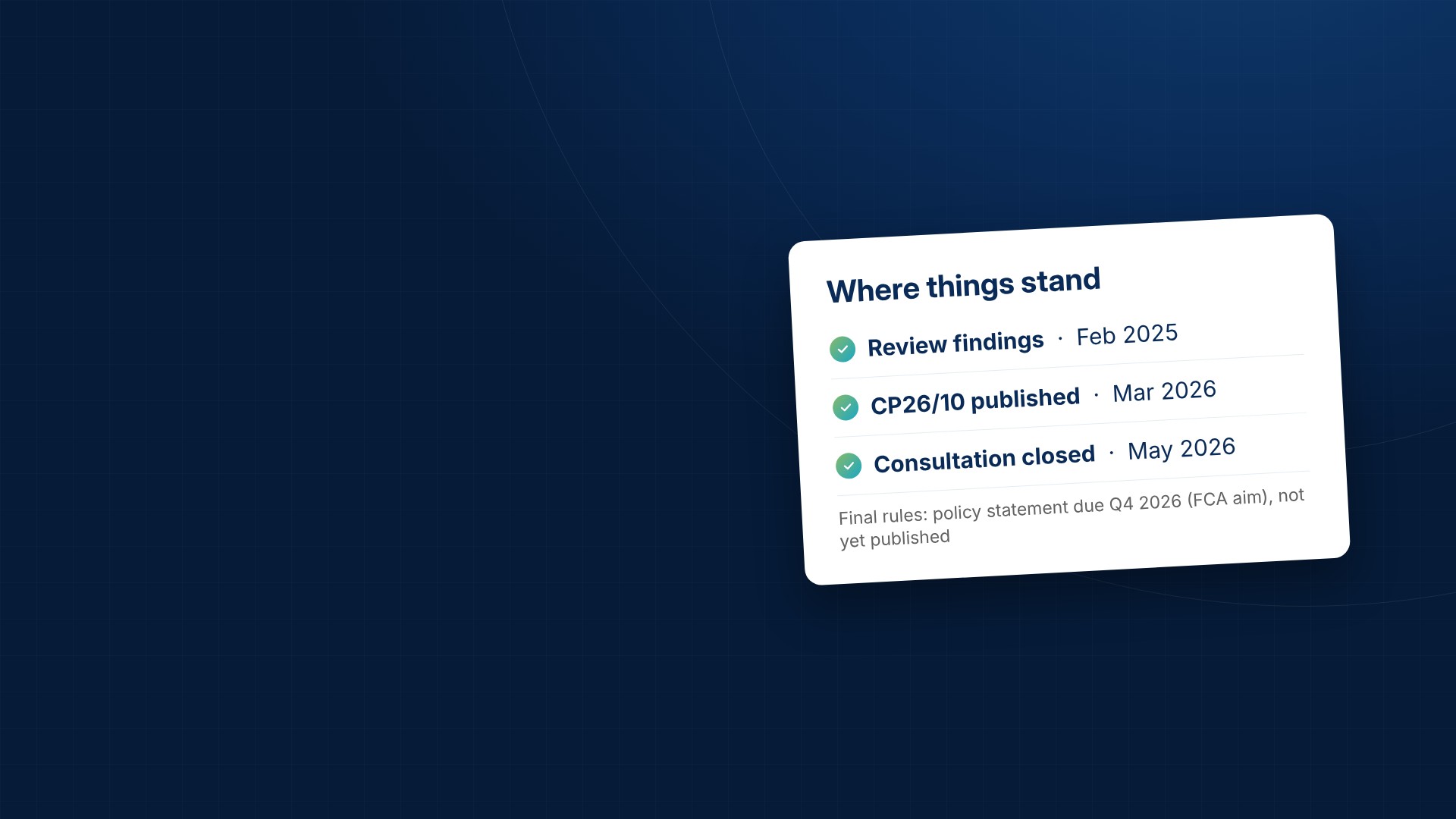
On 15 February 2024 the FCA wrote to 22 of the largest advice firms and asked for seven years of data on ongoing services. It published the results on 24 February 2025 (FCA review). It looked at suitability reviews, because the firms' ongoing services generally included one.
In the cases where a review was promised:
- Reviews were delivered in around 83%.
- In about 15%, the client declined or didn't respond.
- In fewer than 2%, the firm made no attempt to deliver it.
The FCA said it did not currently view the problem as systemic. It still set out what it expects of every firm offering ongoing advice:
- Check whether you can show you delivered the services in your client agreements, or required by FCA rules.
- Consider whether to contact clients proactively to assess whether any harm was caused. Firms carrying out proactive reviews should look back to 2018.
- Where no review was attempted, redress is likely to be due. Partial redress may be right where some of the service was delivered.
- Where a client has declined for a long time, discuss with them whether continuing the service is still in their best interest.
Redress is less likely where the firm was ready, willing and able to deliver and the client consciously declined. That only helps if you can show the offer was made.
Several of the FCA's checks turn on records. It named inadequate record-keeping as poor practice. On the good side, it pointed to policies that stop fees once a client hasn't engaged for a period.
What CP26/10 proposes for ongoing advice
On 25 March 2026 the FCA published CP26/10, its consultation on simpler pensions and investment advice rules. Three proposals would change how ongoing advice works:
- Review frequency set by need. The FCA proposes removing the annual suitability requirement in COBS 9A.3.9R and 9A.3.10R. Firms would instead set the review frequency "based on an assessment of customer needs and circumstances" (para 3.14).
- Charging without a new recommendation. It proposes to clarify that firms can offer and charge for an ongoing service "whether or not they give a new personal recommendation on each occasion" (para 3.8).
- Guidance on disengaged clients. There are no specific Handbook rules today on clients who keep paying but stop engaging. The FCA proposes high-level guidance rather than prescriptive rules, and says the guidance "does not create new standards" (paras 3.21 to 3.25).
It also says that "continued charging without meaningful delivery would ultimately breach their Consumer Duty obligations" (para 3.28).
The consultation closed on 22 May 2026. The FCA said it aimed to publish a policy statement in Q4 2026 (para 1.25). As of 5 November 2026, the policy statement has not been published. CP26/10 also proposes simpler suitability reports, covered in our piece on targeted support.
These are proposals, so the current rules still apply until the FCA confirms final rules. If the final rules land close to the proposals, review frequency would be set by client need, and a record of how each client's frequency was set is likely to be needed to evidence it.
What to evidence now
Whatever the final rules say, the FCA's 2025 findings point to one record for each client paying an ongoing fee:
- What the client agreement promises, and how often.
- When each review was offered, and how.
- What was delivered, with the documents.
- If the client declined or didn't reply, the offer itself and any follow-up.
Then there's the firm-wide view. Under the Consumer Duty, a firm's governing body must review and approve a report on customer outcomes at least once a year. When the FCA looked at those board reports (FCA, December 2024), it found some firms didn't have the data quality to support their conclusions. Others relied on high-level claims, or leaned too heavily on one type of measure.
The better reports paired the data with conclusions and checked whether actions worked. A count of reviews held can show the process ran; on its own, it may not show what changed for clients.
The FCA points to complaints data and client feedback, and for smaller firms to Financial Ombudsman Service data, trade body benchmarking and a "critical friend" who can give an impartial view. Your review records can feed the board report directly, if you capture them as you go.
How to tier the service if reviews stop being annual
If review frequency becomes a matter of client need, you would need a way to decide it and a record of why. One approach is to group clients by what drives their need for contact:
- Clients drawing an income, or close to retirement.
- Clients with a life event under way, such as a house sale, an inheritance or a business sale.
- Clients with characteristics of vulnerability.
- Clients with stable circumstances and a long-term plan.
Each group can carry a review frequency, the trigger that moves a client up a group, and what the fee covers between reviews. That last point counts under para 3.8: if a fee can be charged in a year without a new recommendation, a clear statement of what the fee covers can help show delivery.
A policy for clients who stop engaging
The FCA hasn't written prescriptive rules here, and it says its proposed guidance does not create new standards. It does expect firms to have policies for clients who are no longer receiving the service they pay for (CP26/10, para 3.21). A policy can cover:
- When a client counts as disengaged: how many offers, over what period, through which channels.
- How you try to re-engage them, and how you record each attempt.
- When you discuss whether the ongoing service is still in their best interest.
- When you stop collecting the fee, and whether any refund is due.
Write it down, apply it consistently, and keep the record.
Five checks for this quarter
- Pick ten clients on an ongoing fee and check you can show, for each, the last review offered, delivered or declined.
- Read your client agreement and note exactly what it promises, and how often.
- Write or update your disengaged-client policy, including when fees stop.
- Draft your client groups and a review frequency for each, ready if the rules change.
- Check the FCA's CP26/10 page each month until the policy statement is out.
On JustFA
On JustFA, client reviews are scheduled automatically. Each review starts from a fact-find pre-filled from the last one, and the review documents are generated from the firm's own templates. In JustFA 2.0, the adviser opens the Recommendation Wizard during a review. From there they can check or amend the ongoing service, change payments, add a transfer or account, and generate the Annual Review document. Documents, signatures and communications are kept in one audit trail.
Where this leaves firms
Most of the work the FCA's review points to doesn't depend on the final rules.
If you can show what each client paid for and what they got, a change to review frequency becomes an update to your process rather than a project.
Common questions
What did the FCA find in its review of ongoing advice?
The FCA asked 22 of the largest advice firms for seven years of data and published its findings on 24 February 2025. Suitability reviews were delivered in around 83% of the cases where they were promised. In about 15% the client declined or did not respond, and in fewer than 2% the firm made no attempt. The FCA said redress is likely to be due where no review was attempted, and asked firms to consider whether to contact customers proactively, with proactive reviews looking back to 2018.
Has the FCA removed the annual suitability review requirement?
Not yet. In CP26/10, published in March 2026, the FCA proposed removing the requirement for periodic suitability assessments to be at least annual and letting firms set review frequency based on an assessment of each client's needs and circumstances. The consultation closed on 22 May 2026 and the FCA said it aimed to publish a policy statement in Q4 2026. As of 5 November 2026, that policy statement had not been published, so the current rules still apply.
Can an advice firm charge an ongoing fee without giving a new recommendation?
CP26/10 proposes to make clear that firms can offer and charge for an ongoing service whether or not they give a new personal recommendation on each occasion. The service still has to be delivered: the FCA says continued charging without meaningful delivery would ultimately breach a firm's Consumer Duty obligations. The proposal is not final until the FCA publishes its policy statement.
What should a firm do about clients who decline or ignore review offers?
The FCA's 2025 review said redress is less likely where the firm was ready, willing and able to deliver and the client consciously declined, so a record of each offer matters. For clients who decline over a long period, the FCA expects the firm to discuss whether the ongoing service is still in their best interest. It named policies to stop collecting fees from clients who have not engaged for a period as good practice.
How far back should firms check ongoing advice delivery?
In its February 2025 findings, the FCA said firms should consider whether to contact customers proactively to assess whether any harm was caused. Firms carrying out proactive reviews should look back to 2018.
JustFA
Reviews, documents and records in one system
JustFA runs the adviser back office, the investment platform and the client portal as one system. It is used by 50+ UK advisory firms, with no setup fee and a standard four-week go-live.